Walt Disney's Greatest Storyman
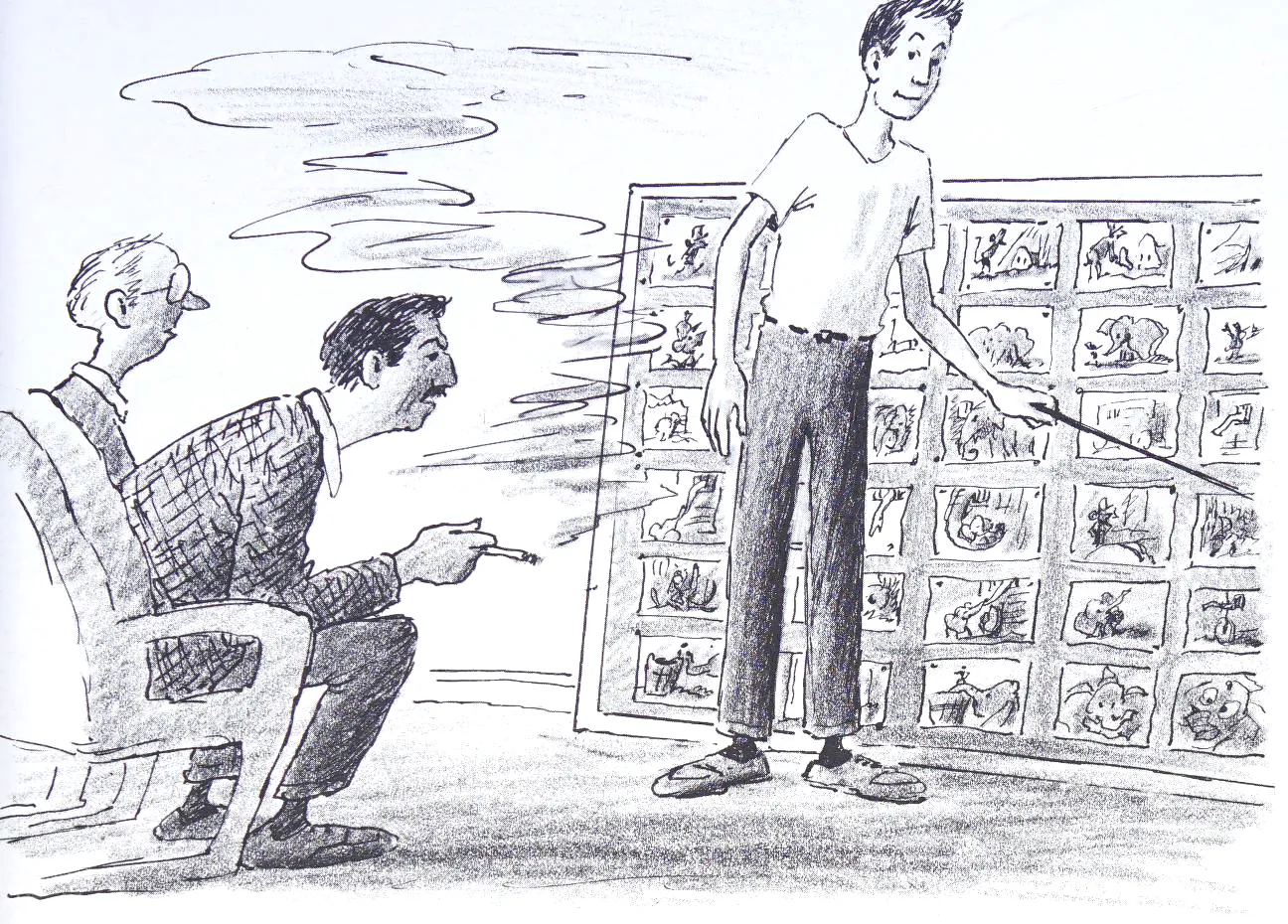
"Walt the wizard never knew that I patterned Merlin the magician after him… I even borrowed Walt's nose."
FROM HIS AUTOBIOGRAPHY (pp. 171–172)
The Greatest Story Sketches
On Dumbo Bill rescued a faltering sequence by the great Bill Tytla, redrawing “every damned frame” to Walt’s delight. He came up with Dumbo’s final character design, and his infant son Bill Jr. shaped how he drew the baby elephant. After the 1941 strike, which Bill joined on principle and after which Walt pointedly kept him on, he became a full story man who did his own sketching. His Song of the South story sketches for the “Laughing Place” became legendary among the animators, who used “just about every pose Peet came up with.”
The Only Man to Storyboard a Feature Alone
He rose to chief storyman, and on 101 Dalmatians and The Sword in the Stone he did what no one else ever had: he storyboarded an entire Disney feature alone. For Dalmatians he wrote the screenplay and every line, cast and directed the voice of Cruella de Vil, and designed her. Author Dodie Smith thought he had improved her book, and his signature was animated into the credits, an unheard-of honor. For Sword in the Stone, his own suggestion, he modeled Merlin on Walt himself, “even borrowed Walt’s nose,” a private joke Walt never caught.
A Collision and a Kinship
It was a relationship of profound creative collision and, in its way, deep mutual respect. One Sunday Walt phoned him at home just to say he liked the script “so you wouldn’t have to worry about it the whole weekend.” Another day he slumped in Bill’s chair and confided, “It gets lonely around here… I want this Disney thing to go on long after I’m gone.” For a time, Bill was as close to the center of the studio’s storytelling as any single artist could be. Historian John Canemaker would later call him “Walt Disney’s greatest story man.”
"It gets lonely around here… I want this Disney thing to go on long after I'm gone. And I'm counting on guys like you to keep it going."
WALT DISNEY, QUOTED IN HIS AUTOBIOGRAPHY (p. 176)