An Indiana Boyhood
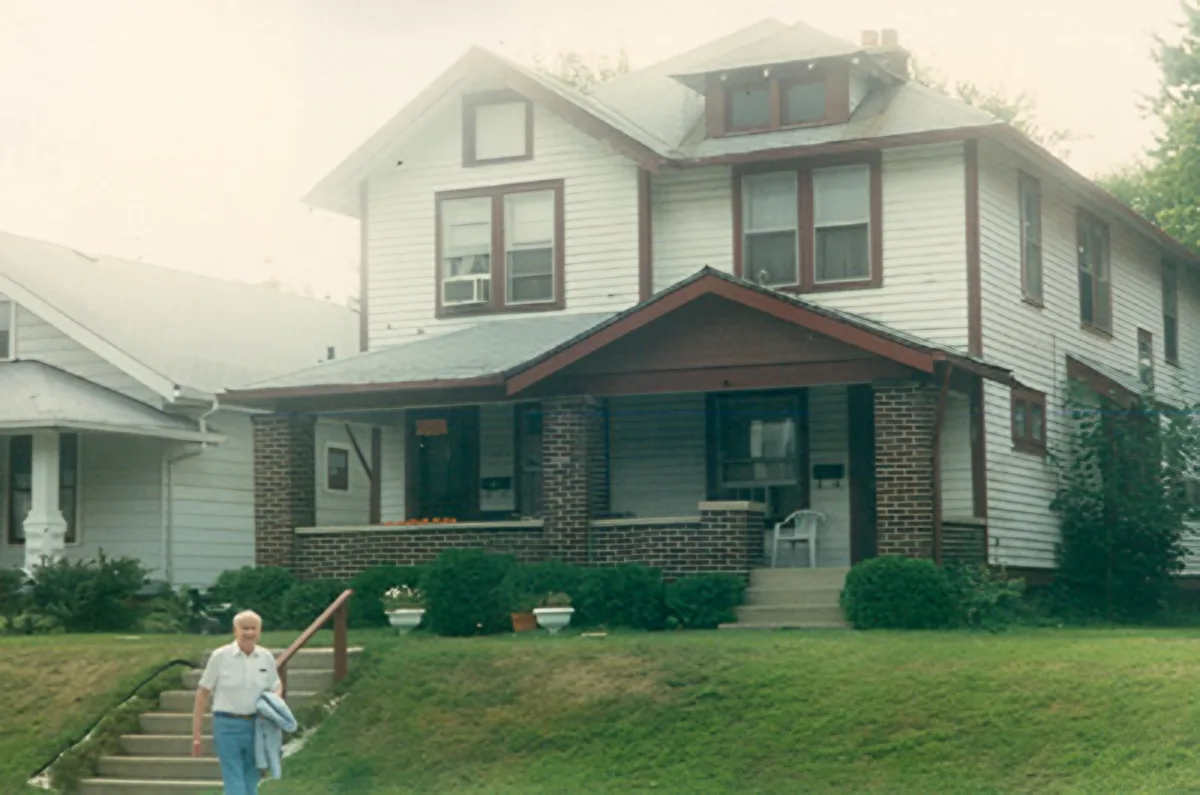
"Drawing became my number one hobby as soon as I could manipulate a crayon or pencil."
FROM HIS AUTOBIOGRAPHY (p. 8)
Life on North Riley Avenue
William Bartlett Peet was born in the Ohio River town of Grandview, Indiana, on January 29, 1915. His earliest visual memory was the two pigs his family raised there. His father was drafted into World War I before Bill turned three and, after the war, never came home; for years the family was told only that he was “a traveling salesman out on the road somewhere.” Bill’s mother, a trained teacher, moved her three sons to Indianapolis, where his widowed grandmother ran the household. The absence of a father barely registered, “except for the times when other kids would taunt us about not having a daddy.”
His happiest years were spent on North Riley Avenue, drawing for hours in the attic. “Drawing became my number one hobby as soon as I could manipulate a crayon or pencil.” He drew on the sly through every class, filling the margins of his textbooks; come the used-book sale, “my illustrated books were best sellers.” Summers meant creek “safaris” for frogs and tadpoles, trips to Union Station to memorize the great locomotives, and stays at his grandfather’s hardscrabble southern Indiana farm. On Memorial Day he hawked race-day editions in the infield of the Indianapolis 500, a “real bonanza,” though “I was never a racing fan and never cared who won.”
Nature, Animals, and the Tug of War
Two boyhood threads ran straight into his life’s work. One was animals: a vivid tug-of-war in which a water moccasin snatched a frog from his hand left him with a lifelong unease at “nature’s cruel ways of keeping a balance among the animals… all the savagery and the suffering.” The other was pollution, “the slow, silent death caused by poisonous waste spilling from pipes down into the creek… where dead fish floated belly up.” Both would surface again and again in his books. His reading hero was the naturalist Ernest Thompson Seton, whose realistic, sad-ending animal stories “nearly brought me to tears, and yet I read them again and again.”
When the Idyll Ended
The idyll ended in 1928, when his father reappeared, broke, demanding money for one more failed sales venture. The quarreling was ceaseless; one night Bill called him “a big bully” and “caught a fist in the head.” Amid the strife his grandmother died of a heart attack, a moment that “haunted me for many years.” The house was sold, and the family fell into renting, moving, and “our own unique brand of poverty.”
"It has always been difficult for me to accept nature's cruel ways of keeping a balance among the animals, all the savagery and the suffering."
FROM HIS AUTOBIOGRAPHY (p. 17)